
Motorcycle Shift Pattern: How Gears Work
SOURCE: KOVE
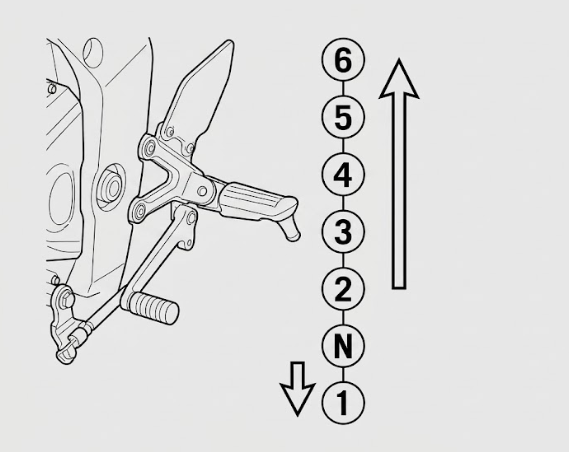
A motorcycle shift pattern defines the order of gears and the direction in which a rider moves the foot lever to change gears. On most conventional motorcycles, the standard sequential layout is 1-N-2-3-4-5-6:
First gear (1) is selected by pressing the shift lever down from neutral.
Neutral (N) is located between first and second gear.
Higher gears (2–6) are selected by lifting the lever upward.
Five-speed gearboxes feature one fewer forward ratio, while specialized designs or race setups may utilize alternative mechanisms or reverse shift patterns. However, a motorcycle’s external shift pattern describes how a rider selects a gear, not how the internal transmission components operate.
What Is a Motorcycle Shift Pattern?
A shift pattern is the pattern of motorcycle gears and the way the shift lever is used.
Unlike automotive transmissions that often allow direct gear skipping via a “H-pattern” gate, motorbikes normally use a sequential transmission. This implies the rider has to change up or down gear by gear in a precise way.
| Gear Position | Standard Shift Operation | Mechanical Positioning and Notes |
| First Gear | Press down from N | Used for starting and low speed riding |
| Neutral | Soft transition from first to second gear | Internal gearbox non power transfer position |
| Second Gear | Up from first through neutral | Changes to a higher forward gear. |
| 3-6 Gear | Gear-to-gear lift | Exact top gear depends on gearbox design (five or six speed) |
Shift Pattern vs Gear Ratio
Shift Pattern:The shift pattern just tells you which way the rider is pushing on the foot lever to select a gear.
Gear Ratio:Gear ratio is the ratio of the speed of the gearbox input shaft to the speed of the output shaft. It directly influences torque multiplication and power responsiveness at a particular road speed.
How Does a Sequential Motorcycle Gearbox Work?
Most manual motorcycles have a constant-mesh transmission. Usually gear pairs on the main shaft (input shaft) and countershaft (output shaft) are meshed physically in this arrangement. Some of the selected gears are fastened to the shaft by sliding gears or dog clutches.
When the rider presses or pulls the change lever, the internal mechanical route is:
Shift Shaft & Ratchet Mechanism: The foot pushes the shift lever, which turns the shift shaft and moves the ratchet mechanism to the next fixed angle.
Shift Drum Rotation: The ratchet rotates the shift drum. The outer surface of the shift drum contains carefully constructed curved grooves.
Shift Forks Move Laterally: The grooves in the shift drum engage the guide pins of the shift forks and, as the drum turns, the forks are compelled to move laterally along the axis.
The shift forks move the sliding gear or dog clutch axially so that the dog clutch dogs engage the correct dog clutch slots. This locks the otherwise freely revolving gear to the corresponding drive shaft. The specific engagement components and the layout is based on the gearbox construction.
Detent mechanism locking: The detent mechanism assists in retaining the shift drum in the positioning position of the corresponding gear, thereby providing accurate gear locking.
How Do Gear Ratios Affect Motorcycle Performance?
The transmission’s main job is to change gear ratios, which allows the engine to run at an efficient RPM range at varied speeds on the road.
Formula for Total Drive Ratio
The overall power performance of the vehicle is determined by the total drive ratio, computed as:
itotal = iprimary × igear × ifinal
iprimary:Primary drive ratio (crank shaft to gearbox input shaft)
igear:current gear ratio (input shaft to output shaft)
ifinal:Final drive ratio (countershaft small sprocket to rear wheel large sprocket)
Example: Relationship between Gear Ratio and RPM
Suppose some gear has a gearbox gear ratio (igear) of 2:1. This means that the input shaft turns twice for every rotation of the output shaft. If the speed of the gearbox input shaft is 4000 RPM, the speed of the output shaft is 2000 RPM. If an upshift results in a gearbox gear ratio of 1:1 then the output shaft speed is increased to 4000 RPM at an input shaft speed of 4000 RPM.
Note: The above data are used to show just changes in output shaft speed from the gearbox. The actual wheel speed and road speed also depend on the primary drive ratio, final drive ratio, tyre rolling circumference and the quality of the clutch engagement (without sliding).
Gear Selection Effects
Low Gears: The numerical gear ratio is larger, thus there is a lot of torque multiplication at the wheel, but the engine speed is relatively high for a given road speed.
High Gears: Lower gearbox reduction ratio. This can be a very effective way to reduce engine speed at the same road speed. Wheel torque output goes down, however.
Engine Braking: When you downshift, the higher gear ratio will immediately raise engine speed and create an engine braking effect. The operation should be properly matched with the road speed of the rider to preserve smooth vehicle behaviour.
How to Shift Gears Smoothly
Exact coordination of clutch, throttle and shift lever motion is required for seamless shifting. In stop-and-go traffic it’s important to be able to accelerate and decelerate a lot. The primary scenarios are according to different help systems and operation methods:
Clutch-Assisted Shifting (Conventional): The rider pulls the clutch lever and disengages power transfer. The torque unloading during shift reduces the load on the engagement mechanism. The rider presses down or pulls up the shift lever with some force to lock the gear and then slowly releases the clutch.
Quickshifter for Upshifting: Many modern motorcycles come with a quickshifter. A quickshifter usually works by detecting a change in force or displacement on the gear shift lever and sending a signal back to the engine management system. At the shift, the system briefly switches ignition control or fuel control to take load off of the transmission. This allows the rider to upshift under specific conditions without using the clutch or closing the throttle manually. Depends on the model. The specific control method and supported direction (one-way / two-way).
Downshifting and Rev-matching: When you downshift, you have to be careful about matching engine speed to which gear you want to be in. Some models that include 2-way quickshifters and auto-blip functions can assist electrically with this process to make downshifts more seamless.
Standard vs. GP Shift Pattern
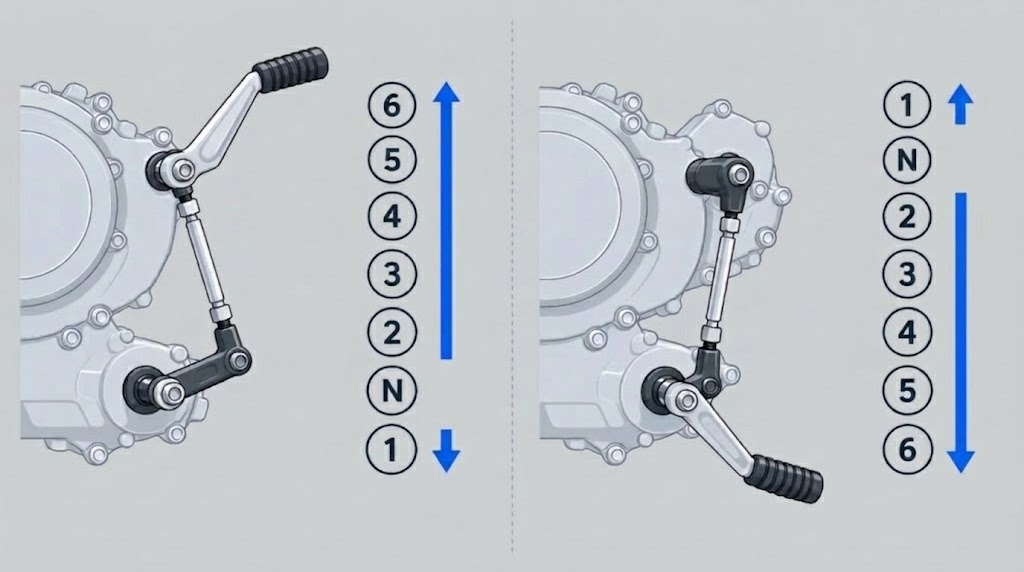
The GP Shift, often employed by track riders, is exactly different to the usual shift pattern in external operating logic:
| Comparison Dimension | Standard Shift (Standard Forward Shift) | GP Shift (Reverse/Track Shift) |
| 1st Gear Operation Direction | Press Down (Downward Press) | Lift Up (Upward Lift) |
| Higher Gear Operation | Lift Up for each higher gear | Press Down for each higher gear |
| Linkage Mechanism Change | Original factory direct connection or conventional linkage configuration | Usually changes the transmission direction by flipping the shift lever or modifying the reverse linkage |
| Main Application Scenarios | Street cruising, daily commuting, and most mass-market vehicles | Part of track environments and sport riding |
| Operation Adaptation and Risks | Complies with the majority of riders’ intuition and muscle memory | Reverses the conventional logic. Failure to fully adapt may lead to incorrect operation |
Important mechanical note: GP Shift reverses the direction of the external shift action. That does not mean that the internal gear ratios or sequence in the gearbox need to change. The method of doing this depends on the shift linkage and model design.
Why Is Neutral Hard to Find?
Neutral is not a gear position that transmits power independently. This is a selection position where no forward drive connection is made in the gearbox.
The difficulty in locating neutral or aberrant gear engagement is frequently connected to the following mechanical and operational factors:
Excessive operation travel: Neutral is between first and second gear. For neutral finds, large pressures or lifts are frequently harder than gentle and exact action.
Clutch Drag: Excessive clutch free play or abnormality in the hydraulic/cable system can cause the clutch to not entirely disengage and residual power transmission can occur at the input shaft. This is one way to troubleshoot resistance to gear engagement.
False Neutral: This is a condition where the shift motion is not complete and the gear dogs are not fully engaged. There are other possible dangers, such as abrupt power loss and mechanical shock during re-engaging. If gear engagement problem, abnormal noise or anomalous shift lever function still occurs, halt forced operation. Trouble-shooting should be performed according to the owner’s handbook or by a professional repair expert.
Do All Motorcycles Have the Same Shift Pattern?
The configuration dimensions of different motorcycles are radically different in terms of number of gears, sequence of shifting, and clutch construction.
The arrangement of the gearbox system of a particular model should be determined from the official specifications and the owner’s handbook. We should follow the official operating instructions of the appropriate version as to the gear operation direction, however we can check the gearbox and clutch specifications for the publicly posted model information of the KOVE model. Don’t get all excited about a “six-speed gearbox.”
How to Check Your Motorcycle’s Shift Pattern
While general shift diagrams can help grasp the basic concepts of a constant-mesh gearbox, they must never replace the official instructions for a particular model. To check the configuration, perform the following steps:
Check Specific Vehicle Version: Check the full model name, production year and market version of your motorcycle.
See the Official Service Manual: Refer to the owner’s manual for the correct model for officially specified gear count, shift logic and operating criteria.
Shift Modifications: If the bike has aftermarket rearsets or a reverse shift linkage, verify the exact shift direction before riding. If a quickshifter is fitted, check supported operation modes and compatibility individually according to the manufacturer’s recommendations.
Final Thoughts
Understanding a motorbike shift pattern is basically understanding how the foot operation alters the gear ratios of a constant mesh gearbox through the shift drum and shift forks. No matter if you are performing regular or GP shifting, smooth shifting depends on proper torque unloading, suitable rev matching, and understanding of the mechanical features of the given model. First principle is always to refer to the official owner’s handbook if there is any abnormality in the gear engagement to ensure riding safety and mechanical durability.