
The Complete Guide to Adventure Motorcycles for Highway Comfort and Gravel Control
SOURCE: KOVE
Picture a typical ride: 300 km of highway to reach a region you want to explore, then an hour of gravel to get to the best part. Most adventure motorcycles claim to handle both. In practice, the choices that make a bike calm at 120 km/h often make it harder to manage on loose stone, and the reverse is also true.
Quick answer: No single spec decides whether an adventure motorcycle suits you. Highway comfort and gravel control often pull in opposite directions, so the right bike depends on your route mix, load, experience and body size.
What “Gravel” Actually Means for Your Bike
“Gravel” covers very different surfaces, and each asks something different of a motorcycle:
- Maintained gravel roads: firm, fairly even, and usually fine for a road-biased bike with sensible speed.
- Graded dirt roads: generally manageable, but they can turn slippery or rutted after rain.
- Loose gravel and uneven tracks: here weight, tires, suspension and throttle control start to matter a lot.
- Technical off-road terrain: a different category, and not what this guide covers.
Most riders searching for adventure motorcycles are weighing highway touring against the first three. Knowing which one you’ll meet most often is the first step toward a good choice.
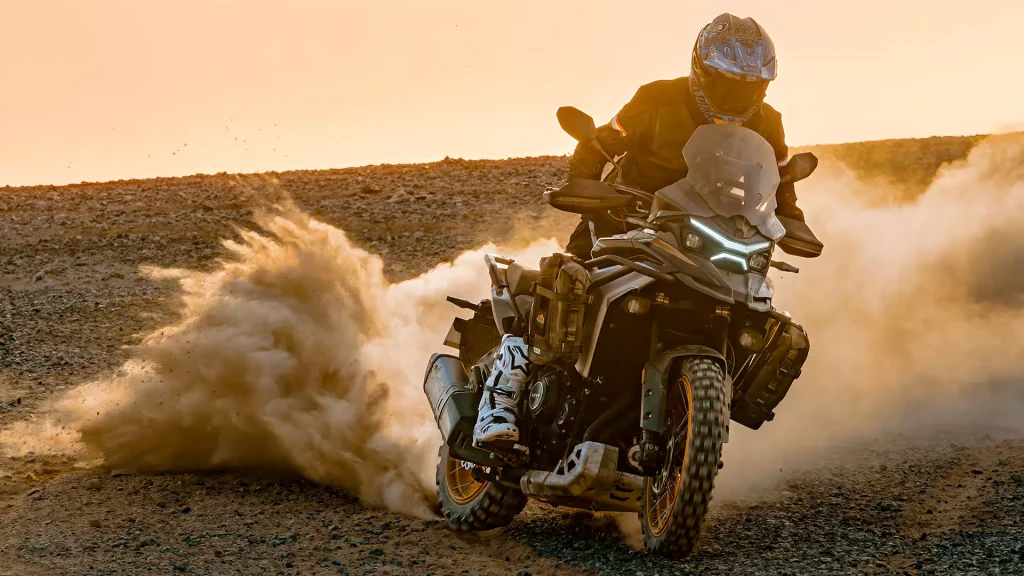
What Makes an Adventure Motorcycle Comfortable on the Highway
Riding position. An upright posture spreads load across shoulders, wrists, back and knees, which matters after several hours. It also lets you stand on the pegs when the road turns rough, so the position is useful in both worlds.
Wind protection. Screen height, width and airflow direction decide how much wind pressure and noise reach your chest and helmet. Because this depends on your height and helmet shape, it is one of the things you can only judge by riding the bike.
Power reserve. What matters is not peak figures but whether the engine pulls cleanly at highway speed, when overtaking, climbing, and carrying luggage. More displacement isn’t automatically better for every route, since it can add weight and cost.
Vibration and refinement. Cylinder count alone doesn’t tell you how smooth an engine feels. Crankshaft configuration, balancing and mounting all play a part, so treat smoothness as something to test, not assume.
Seat, suspension and tank. A well-shaped seat with room to shift position helps over long days. Suspension has to stay composed at speed, absorb joints and bumps, and still support a loaded bike. A larger tank means fewer fuel stops, but unless you have reliable consumption data, avoid turning tank size into a range promise.
Comfort features. Cruise control earns its place on long, steady highway stretches. Heated grips and a heated seat matter in cold climates. Navigation display helps on unfamiliar routes. More features don’t automatically mean a better fit, so ask whether you’ll actually use each one.
What Gives You Control on Gravel Roads
Weight and center of gravity. Weight shows up in slow-speed turns, parking, U-turns and, most importantly, picking the bike up after a tip-over. Always check whether a quoted weight is the bike alone or with luggage.
Wheels and tires. Wheel diameter, tire construction and tread pattern shape both road stability and gravel grip. For tire pressure, follow the tire maker’s guidance, then adjust for load and surface. There is no universal number.
Ground clearance and suspension travel. More clearance helps you avoid rocks and ruts, and more travel absorbs bigger bumps. The cost is usually a taller seat, harder footing at a stop, and sometimes a different feel on pavement. Longer travel is not automatically more comfortable or safer.
Damping and preload. These settings should change between a solo, lightly loaded ride and a fully packed one.
Handlebar and steering. Bar position affects how natural it feels to stand, make slow corrections and hold a line.
ABS and traction control. These aids can help on loose surfaces but have limits. Read the manual for your specific model so you know what each mode does.
Throttle response. A smooth, predictable throttle reduces abrupt reactions on loose ground.
Luggage and accessories. Panniers, top boxes and crash bars add weight, raise the center of gravity and widen the bike. That changes how it handles on both asphalt and gravel.
The Trade-Off: Why No ADV Does Everything Best
This is the heart of the decision. Every advantage has a price:
- More weight can feel stable at speed, but makes low-speed moves and recoveries on loose ground harder.
- Longer suspension travel handles bigger undulations, but doesn’t automatically mean more comfort, and it usually raises the seat.
- A larger front wheel can help with obstacles, though tire choice, frame geometry and tuning matter as well.
- Higher seat and clearance suit rough terrain, but not every rider’s height, leg length or confidence.
- More power helps with overtaking and loaded climbs, yet bigger isn’t better for every route.
- Bigger screens, luggage systems and comfort features help on tour, but add weight, cost and size.
A touring-focused adventure motorcycle can work on occasional gravel. How well it works depends on the surface, your load, your tires and your confidence.
This is the heart of the decision. Every advantage has a price: more weight can feel stable at speed, but makes low-speed moves and recoveries on loose ground harder. Longer suspension travel handles bigger undulations, but doesn’t automatically mean more comfort, and it usually raises the seat.
How to Choose: Match the Bike to Your Riding Mix
Before comparing models, answer these questions honestly:
- What share of your trips is highway?
- How often will you ride gravel?
- Is it graded and even, or loose and rutted?
- How experienced are you with larger adventure bikes and slow-speed maneuvering?
- Can you plant both feet confidently, and are you comfortable with the bike’s weight?
- Will you ride loaded or with a passenger?
- Are your trips weekend runs or multi-day tours?
- Have you considered tire, maintenance and accessory costs?
| Your situation | Prioritize | Can matter less | Watch out for |
| Mostly highway, occasional gravel | Screen, seat, power reserve, cruise control | Very long suspension travel | Tire grip and slow-speed weight |
| Balanced road and gravel | Weight and seat height balance, adjustable suspension, tire choice | Maximum wind protection | Compromises at both ends |
| Frequent gravel | Clearance, suspension, weight, rider-aid modes | Some comfort extras | Highway fatigue and seat height |
| Long tours with luggage or a passenger | Power reserve, preload adjustment, load rating, fuel capacity | Minimum weight | Low-speed handling when loaded |
| Manageable weight and low-speed confidence | Curb weight, seat height, footing | Peak power | Margin when fully loaded |
No spec decides it alone, and a test ride beats any table.
KOVE ADV Models as Reference Examples
KOVE’s Models lists four ADV motorcycles: the 800X TOURING, 625X, 800X PRO and 525X. Two of them show how the trade-offs above play out. All figures below come from KOVE’s official pages and may vary by market and version, so confirm with your local dealer.
KOVE 625X: Road Touring, Daily Riding and Light Off-Road
If your riding is a mix of commuting, road trips and the occasional dirt detour, the KOVE 625X is a useful reference. KOVE lists a 581cc parallel-twin with a 270° crankshaft, around 46 kW and 56.5 N·m of torque. The curb weight is 221 kg (239 kg with three cases), the seat height is 820/850 mm on the PRO and 795–820/825–850 mm on the MAX, and the bike rides on a 19-inch front and 17-inch rear wheel. Suspension travel is 180 mm front and 230 mm rear, with 205 mm of ground clearance.
Read those numbers in terms of your own riding. The seat height range and weight affect whether you can comfortably U-turn or back out of a tight spot. The 19/17 wheel setup is a typical road-and-gravel compromise. On comfort, KOVE lists a manually adjustable windscreen, heated seat and grips, traction control and tire pressure monitoring. Note that the electronic rear suspension appears on the MAX version, while the PRO uses an adjustable KYB shock. How the windscreen and seat actually feel on a long day is something only a ride can tell you.

KOVE 800X TOURING: Long-Distance Comfort with Light Off-Road Ability
If your priority is long highway days, often with luggage, the KOVE 800X TOURING is a more touring-oriented reference. KOVE lists an 799cc parallel-twin making roughly 70 kW and around 79–80 N·m depending on market. The seat height is 826 mm, ground clearance is 230 mm, the wheelbase is 1,520 mm and the tank holds 22 L. Suspension travel is 210 mm at both ends, with KYB preload adjustment, and it runs 19-inch front and 17-inch rear wheels with CST tires.
For long-distance riding, KOVE lists cruise control, a heated seat and grips, a TFT display with phone navigation projection, Bosch ABS, traction control and multiple riding modes including Rain and Off-road. It also describes ergonomic changes such as a raised bar, wider seat and larger windscreen. These are manufacturer claims, so treat them as a reason to test, not as proof of comfort. Weight is quoted at 195 kg, and 215 kg with three cases.
The KOVE 525X and 800X PRO are also on the ADV list, so check these official pages if your needs lean toward more manageable weight or a different balance.
FAQ
Conclusion
The best way to choose among adventure motorcycles is to start with your real route mix, your experience and your load, not a spec sheet. Decide how much highway comfort you need, how much gravel you’ll face, and what weight and seat height you can handle with confidence. Then compare models against those priorities.
To see how this works in practice, browse KOVE’s ADV lineup and book a test ride at a local dealer. Checking the screen, the seat height and the low-speed handling yourself will tell you more than any spec table.