
Best Sportbike for Short Daily Commuting in 2026: What to Look For
SOURCE: KOVE
You can commute on a sportbike and still enjoy the ride. The catch is that what feels thrilling on a mountain road — that forward lean and high-revving power — feels very different when you hit the fifth red light on a Tuesday morning. A solid sportbike for short daily commuting needs to be light, easy to plant your feet down, comfortable for 20 to 30 minutes in the saddle, and smooth at city speeds. Picking one boils down to weight, seat height, riding position, power delivery and a few practical details. We break down what each factor means in real traffic, and how to match them to a short city commute.
Are Sportbikes Practical for Short Daily Commuting?
They can be, but not all of them. Sportbikes are designed around cornering and speed. Commuting asks for something else: patience in traffic, easy parking and comfort on the same route five days a week.
The useful question is how much of the sportbike experience you can keep without paying for it every morning. Some traits are easy to live with, such as sharp styling, good brakes and responsive handling. Others cost you daily, such as extreme weight, a very aggressive posture or a peaky engine.
What counts as a “short” commute? In this guide, we mean a route of about 30 minutes or less each way, mostly on city streets or suburban roads with some stop-and-go traffic. On a route like that, low-speed handling and easy parking matter more than top speed or fuel range. way touring against the first three. Knowing which one you’ll meet most often is the first step toward a good choice.
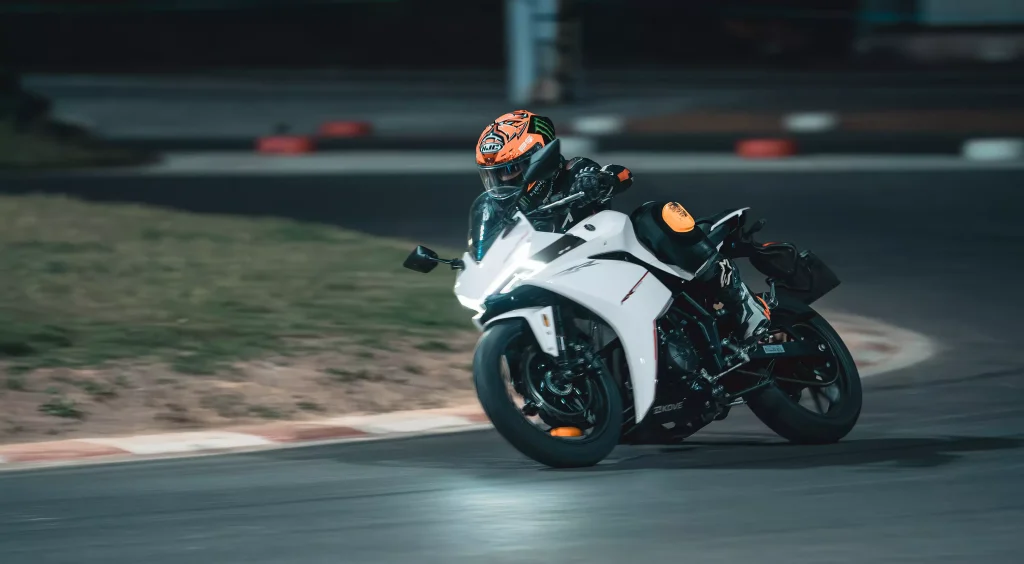
The Quick Answer: What Makes a Sportbike Good for Short Commutes?
| Feature | Why it matters in traffic | Who should prioritize it |
| Lower weight | Easier parking, pushing and slow U-turns | City riders, beginners |
| Manageable seat height | Confidence when stopping and starting | Shorter riders, new riders |
| Comfortable riding position | Less strain on wrists and back | Anyone who stops often |
| Usable power | Smooth, controllable riding at city speeds | Most commuters |
| Low-speed handling and steering lock | Tight turns, filtering and parking | City riders |
| ABS and rider aids | Extra control on wet or slippery roads | Everyone, especially newer riders |
In short, a good sportbike for a short commute is light enough to handle at walking pace, comfortable for your actual ride and predictable in traffic.
Best Sportbikes for Short Commutes in 2026: Our Picks
Within the KOVE Sport range, here is how the three models line up for a short daily commute.
- Best overall for short commutes: KOVE 250RR. At a listed 153 kg with a 790 mm seat height and a 31° steering angle, it is the easiest of the three to park and maneuver. Its 249 cc in-line twin (24 kW at 11,500 rpm) is enough for most city and suburban riding, and it lists ABS on both front and rear brakes.
- Best if you want more performance reserve: KOVE 350RR. At 164 kg with a 344 cc engine (35 kW at 11,500 rpm), it adds power and traction control, and it offers Sport and Eco modes. It suits riders whose short commute includes faster roads.
- Best for commuting plus track days: KOVE 450RR. At 165 kg with a 443 cc in-line four (49 kW at 13,250 rpm), it is aimed at riders who value aggressive riding. It brings inline-four performance to the daily ride and gives you plenty more to enjoy when the commute ends..
Weight and seat height are only two parts of the picture, so the sections below explain what to test for on your own route.

Weight: The Spec You Feel Every Day
Weight matters most when you are barely moving. Pushing the bike out of a tight parking spot, turning around on a narrow street or catching a slow-speed wobble all get easier with a lighter machine. At higher speeds the difference fades, but city riding is full of low-speed moments.
For reference, the KOVE 250RR lists a curb weight of 153 kg, a wheelbase of 1,370 mm and a steering angle of 31°. For comparison, the KOVE 350RR is listed at 164 kg and the 450RR at 165 kg. That is roughly an 11–12 kg difference, which you can notice when maneuvering in a garage or parking lot.
Steering angle also matters. A wider steering lock generally helps in tight turns, so check it alongside weight when you compare bikes.
Seat Height and Confidence at Red Lights
Seat height decides how comfortably you can put your feet down. The KOVE 250RR lists a seat height of 790 mm.
The number alone does not tell you everything. Seat width, the shape of the seat’s front section and your own inseam all affect how flat-footed you feel. Riders who cannot get both feet down often feel less confident at stops and when parking on slopes. Sit on the bike, ideally with your riding boots on, and see how it feels.
Riding Position on a Short Commute: Is the Sportbike Lean a Problem?
For a short commute, a forward-leaning posture is usually manageable. Weight on the wrists and tension in the back and shoulders build up mostly on longer rides, especially when you stop often. If your commute grows beyond an hour, comfort becomes a bigger factor and is worth weighing more heavily.
If you are unsure, take a 30-minute test ride and notice how your hands, neck and lower back feel at the end.
Engine Size: How Much Power Do You Really Use?
A common mistake is assuming that more power automatically makes a better commuter. In the city, you rarely use peak performance. What you use every day is smooth throttle response, easy clutch control and enough power to merge or pass safely.
That does not mean smaller is always better. If your commute includes fast highways, long distances or occasional passengers, extra power gives you more reserve.
The KOVE 250RR uses a 249 cc, in-line twin-cylinder, four-stroke, water-cooled engine with a listed maximum power of 24 kW at 11,500 rpm. For many urban commutes at moderate speeds, that is a reasonable fit, particularly for newer riders. Riders who regularly ride faster roads or want more reserve may prefer a larger option, such as the KOVE 350RR (344 cc, 35 kW at 11,500 rpm) or the KOVE 450RR (443 cc in-line four, 49 kW at 13,250 rpm).
Traffic: Clutch, Throttle and Engine Heat
Stop-and-go traffic tests the details. A heavy clutch tires your left hand. A throttle that responds abruptly makes slow riding jerky. And in hot weather, engine heat can make traffic uncomfortable.
The 250RR uses a water-cooled engine, a common approach to managing engine temperature. Heat in real traffic depends on the bike, the weather and your clothing, so test it: if you can, ride in slow traffic during a test ride and see how your legs and hands feel.
ABS and Electronics: What Actually Helps
Electronics are not gimmicks, but they are not equal either. ABS is the one most worth insisting on. It helps prevent wheel lock under hard braking, which is valuable on wet roads. Research from the Insurance Institute for Highway Safety (IIHS) has linked ABS on motorcycles with fewer fatal crashes.
The KOVE 250RR lists ABS on both the front and rear brakes, plus a TFT instrument display. The KOVE 350RR and 450RR pages both list traction control, and each offers Sport and Eco power modes.
Electronics help, but they do not replace good training. Organizations such as the Motorcycle Safety Foundation offer courses that build low-speed and braking skills.
Maintenance and Running Costs
Commuting wears out tires, chains and brake pads faster than occasional riding. Before you buy, ask about service intervals, parts availability and where the nearest authorized dealer is. KOVE lists its dealers and service information on its website.
Matching the Bike to Your Commute
| Your situation | Prioritize | Can compromise on |
| Short city commute | Light weight, low-speed handling | Top speed |
| Heavy traffic | Weight, clutch and throttle feel, heat | Peak power |
| First sportbike | Controllability, seat height, manageable power | Top speed |
| Commute plus weekend sport riding | Power reserve, handling | Some comfort |
| Long commute | Riding position, fuel range | Ultimate lightness |
Within the KOVE Sport range, the 250RR suits riders who want a lightweight everyday sportbike. The 350RR is for riders who want more performance and added rider aids. The 450RR, with its in-line four engine, is aimed at riders who also value aggressive riding or track use. For a short daily commute, the 250RR is the most natural starting point.
FAQ
Final Thoughts
A good sportbike for short daily commuting lets you keep the style and handling you love without making every ride harder than it needs to be. Focus on how weight, seat height, riding position and power feel on your own route, and let those, not the biggest numbers, guide your choice. To check the KOVE 250RR’s full specifications, visit official KOVE 250RR page.