
How to Choose an Adventure Motorcycle for a Long-Distance Trip
SOURCE: KOVE
Picture five days at around 400 km a day: open highway, mountain roads and the odd gravel connector. That is what an adventure motorcycle is for, and it is where a poor match shows up fast.
The best adventure motorcycle for long-distance riding is the one whose comfort, loaded stability, fuel range and road capability fit your trip, not the one with the biggest numbers. KOVE builds the 800X TOURING for exactly this kind of riding, so this guide uses it as a worked example. Judge it against the same criteria as any other bike.
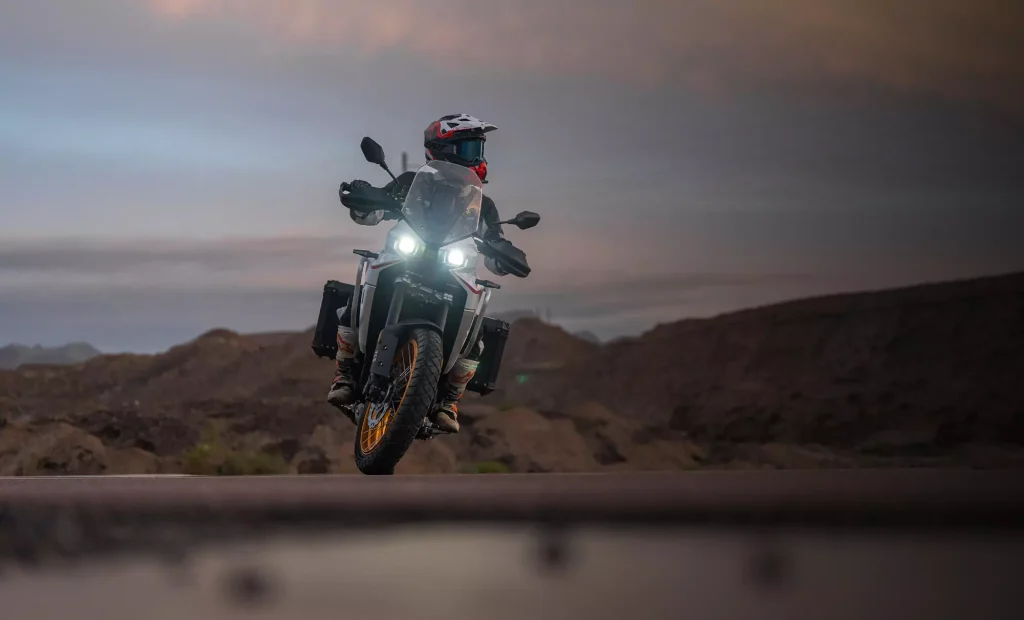
Start With the Trip, Not the Spec Sheet
Answer three questions before comparing bikes: how many kilometres and hours you ride each day, what mix of highway, twisty tarmac and gravel you expect, and whether you ride solo or two-up with luggage. Those answers set your priorities.
| Trip type | Prioritise | Check on the spec sheet |
| Highway-heavy road trip | Wind protection, seat, loaded stability, fuel range | Windscreen, seat width, tank capacity |
| Mountain roads | Chassis balance, brakes, throttle response | Tires, brakes, rider aids |
| Paved roads with gravel sections | Suspension travel, tires, low-speed control | Travel, ground clearance, tires |
| Two-up touring | Power reserve, rear suspension adjustment, passenger comfort | Power, torque, preload adjustment |
If your trip is mostly highway, put cruising comfort and loaded stability first. If it includes gravel, add suspension, tires and low-speed control.
Comfort Over Hundreds of Kilometers
A comfortable adventure motorcycle for long rides is one where nothing starts to hurt at hour four. Seat shape, riding position, wind and heat decide that. Seat height alone tells you very little.
- Seat: look for width and a shape that spreads pressure and lets you shift position.
- Riding position: if the bars are too low or too far, your shoulders and wrists carry the load at highway speed.
- Wind and heat: buffeting tires your neck, and engine heat in slow traffic tires your legs.
On the KOVE 800X TOURING, the handlebar is raised 25 mm and moved 40 mm closer for a more relaxed posture, and the seat is 40 mm wider to reduce pressure. The windscreen is 23 mm taller and 30 mm wider to block wind from your upper body and reduce pressure and noise. A reshaped lower tank guard redirects hot air away from your legs and feet, and heated grips and a heated seat are standard for cold days. Seat height is 826 mm. Comfort is personal, so give any bike at least an hour on a test ride.
Power for Long-Distance Touring
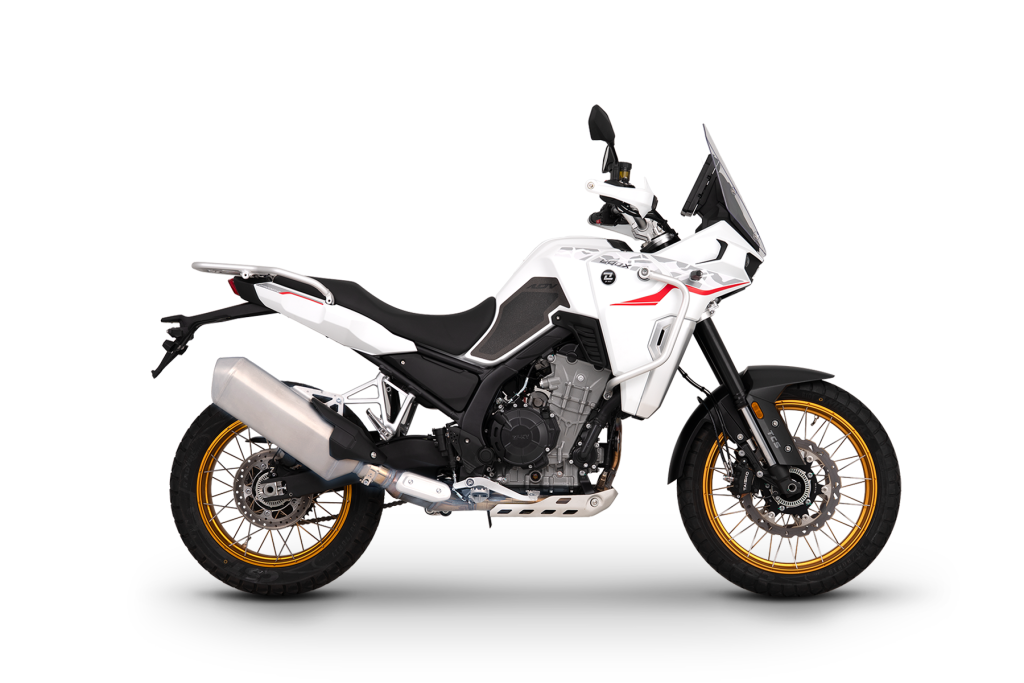
Look for reserve, not just peak output. On a long trip the engine cruises most of the time, so what you feel is whether there is power in hand for overtaking, long climbs and a full load. Bigger is not automatically better: weight, fuel use and how easily you can modulate the power matter too.
The KOVE 800X TOURING E5+ uses a 799 cc liquid-cooled DOHC parallel twin with Bosch EFI and a six-speed gearbox with slipper clutch. It makes 69.5 kW at 9,000 rpm and 79 N·m at 7,500 rpm. KOVE tuned it for smooth low-to-mid rpm response and linear delivery under full luggage, on climbs and at sustained highway speed. Top speed is 210 km/h.
Weight and Loaded Handling
Weight is most obvious when you park on a slope, turn around on a narrow road or ride slowly on loose ground. At speed, centre of gravity, wheelbase and load distribution matter as much. Check what any quoted weight includes, because figures with and without luggage describe different bikes. Lighter is not automatically better either: a light bike can feel unsettled at speed if its geometry is wrong.
The KOVE 800X TOURING weighs 215 kg with three boxes. Its diamond twin-spar frame weighs just 16.8 kg, and the aluminium handlebar, swingarm and spoked wheels keep mass down. KOVE balanced that with a 1,520 mm wheelbase, a 19-inch front and 17-inch rear wheel, and a mid-mounted fuel tank that lowers the centre of gravity, so the bike stays planted on the highway, in corners and in lane changes, even fully loaded.
Seat height should match your inseam and the places you stop. At 826 mm, the 800X TOURING keeps good ground clearance while giving riders confidence at a standstill. If you are shorter, check your footing with the bike loaded.
Fuel Range: Turning Tank Size Into a Plannable Number
Tank size is only half of range. Range is capacity divided by real consumption, and consumption rises with headwinds, speed, climbing, luggage and a passenger. Plan from the longest stretch without fuel on your route, with a margin, using your own measured consumption rather than a brochure figure.
The KOVE 800X TOURING adopts the same one-piece, mid-mounted plastic fuel tank as KVE’s Dakar factory rally bikes. With a 22L capacity and a weight of only 4.4kg, which keeps weight low and the centre of gravity down, and its inner surface is fluorinated to reduce fuel evaporation. Measure your consumption on a long, loaded test ride.
Chassis, Suspension and Tires
More off-road travel and clearance is not automatically better for a long trip. It raises the seat and centre of gravity and can compromise highway manners. Match the hardware to your road mix: highway wants wind protection and road-suitable tires, broken pavement wants travel and a comfortable seat, and gravel wants clearance, tires and low-speed control.
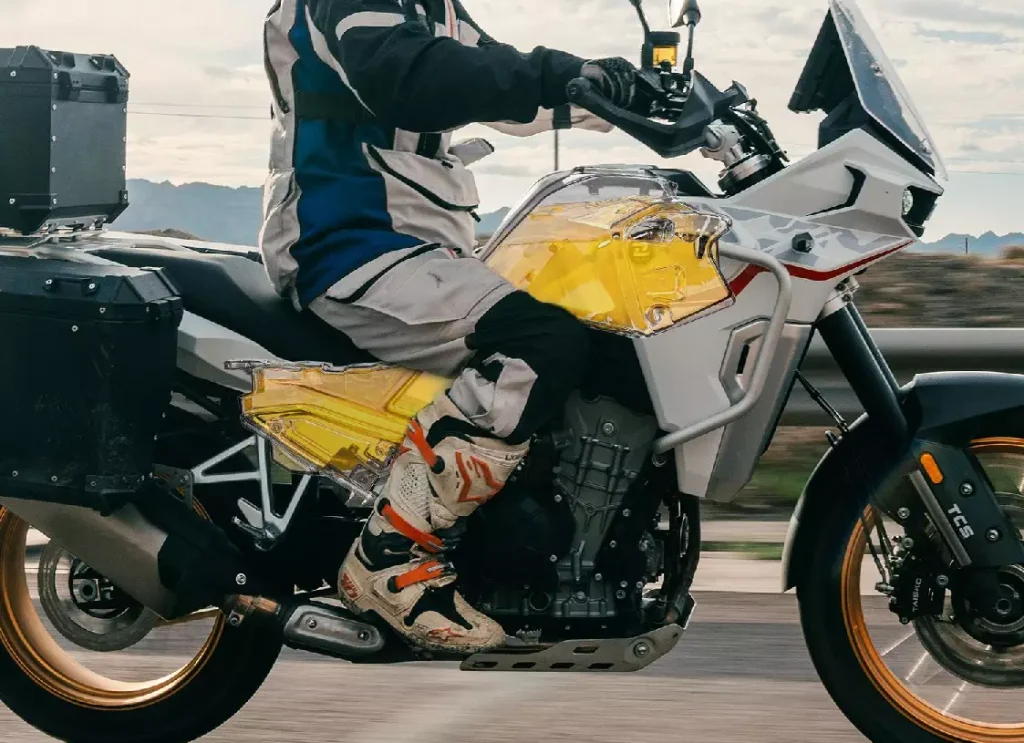
The KOVE 800X TOURING has KYB suspension with a 43 mm fork and 210 mm of travel at both ends, preload-adjustable and tuned for cruising comfort, with extra support available when fully loaded. Ground clearance is 230 mm. Aluminium spoked wheels, 19-inch front and 17-inch rear, carry CST all-terrain tires in 110/80-R19 and 150/70-R17. The larger front wheel helps with obstacles, the rear size supports road stability, and spoked wheels are strong and easy to repair. Brakes are dual floating front discs and a single rear disc.
KOVE positions the 800X TOURING for road touring and light off-road exploration: gravel roads, muddy tracks, mixed surfaces and short unpaved sections. It is not meant for every kind of off-road terrain.
Luggage and Load
Luggage changes how a bike rides. Keep heavy items low and close to the centre, balance left and right, and keep rain gear, tools and documents within reach. Test the loaded bike at low speed before you leave, and set tire pressure and rear preload for the load as the owner’s manual directs. The 800X TOURING’s preload-adjustable rear suspension gives you a way to support extra weight, and its 215 kg weight is quoted with the three-case setup fitted.
Safety and Rider Aids
Electronics earn their place when they solve a problem on your route, and a long feature list is not the same as safety. ABS and traction control help most on wet and loose surfaces, riding modes help when conditions change during the day, and cruise control reduces right-hand fatigue on long highway stretches. None of them replaces judgement, sensible speed and good tires.The KOVE 800X TOURING has Bosch MSC dual ABS, traction control,ride-by-wire throttle and four riding modes: Eco, Sport, Rain and Off-road, the last of which relaxes traction control for light off-road terrain. It also has cruise control, tire pressure monitoring, a 7-inch TFT display with mobile screen projection navigation, a USB charger and LED lighting with daytime running lights.
Maintenance and Trip Preparation
Before a long trip, inspect the tires, brakes, drive system, fluids, lights, fasteners and luggage mounts. Check the owner’s manual for service intervals, load limits and recommended tire pressures. The KOVE 800X TOURING uses a plastic fuel tank and aluminum spoked wheels, but their practical advantages should be assessed alongside repair options, tire construction and parts availability along your route. Before travelling through remote areas, confirm access to suitable servicing and replacement parts.
Is the KOVE 800X TOURING Right for You?
| If you are… | The 800X TOURING offers | Keep in mind |
| A road-focused long-distance rider | Wide seat, taller windscreen, cruise control, heated seat and grips | Test at highway speed for an hour |
| A rider who adds gravel stretches | 230 mm clearance, 210 mm travel, all-terrain tires | Not built for every off-road terrain |
| A two-up or heavily loaded traveller | 69.5 kW, 79 N·m, preload-adjustable suspension | Test it loaded |
| A newer or shorter rider | 826 mm seat, 215 kg with cases | Check footing and low-speed handling |
Whichever bike you consider, use the test ride well. Push it around and turn it in a tight space, ride a highway stretch, stay on it for 30 to 60 minutes, load it if you can, and try a rough section. You can find a KOVE dealer to arrange one.
FAQ
Build Your Own Selection Criteria
Write down your daily distance and road mix, check how a bike behaves loaded, and replace brochure numbers with ones you can measure. Then list three things the bike must do and three you can compromise on. That list will serve you whichever bike you test.
If your trip is mostly road touring with some unpaved sections, the KOVE 800X TOURING is built for it. Book a test ride and see how it fits your trip.