
5 Steps to Choose a Rally Bike for Long Navigation-Based Days Off Road
SOURCE: KOVE
A rally bike that feels exciting for 30 minutes can become hard work halfway through a long navigation day. When your route includes liaison miles, repeated standing, loose gravel, and fuel planning, the wrong choice usually shows up as fatigue, nervous handling, or a bike that is either too compromised for rough ground or too specialised for mixed use. That is why a proper rally bike for long days off road should be chosen around the job it needs to do, not just around styling or peak output.
This five-step process keeps the decision practical. Rather than chasing brochure language, you can narrow your options by ride format, weight, range, ergonomics, chassis behaviour, and ownership support. KOVE’s rally line-up is especially useful here because the three key models cover distinct use cases: the road-legal KOVE 450 RALLY RE, the lighter and more focused KOVE 450 RALLY EX, and the larger-capacity KOVE 800X RALLY .
Step 1: Match the bike type to the day you actually ride
Before you think about power, decide what your long off-road day really looks like. In practice, most riders are buying for one of three patterns, and each points towards a different type of machine.
What to do
- Separate your riding into one dominant use case.
- Be honest about how much tarmac, luggage, and fuel distance you expect.
- Decide whether road legality is essential or just convenient.
- Prioritise the riding day you do most often, not the fantasy trip you may do once.
Three common formats
- Road-legal mixed use: You need to connect paved sections with dirt and still want rally layout and off-road intent.
- Long unsupported off-road days: You care most about fuel range, rider movement, and lower fatigue over hours.
- Aggressive rally-style terrain: You want the lightest, tallest, least compromised package for faster and rougher terrain.
KOVE fit at this stage
KOVE’s range maps cleanly to those scenarios. The KOVE 450 RALLY RE is presented as road-legal and rally-ready, with a 32 L tank, 155 kg curb weight, TFT instrumentation, and high/low seat-height configuration. The KOVE 450 RALLY EX is the more competition-led option, with a 34 L tank, 128 kg curb weight, 960 mm seat height, and 305 mm front suspension travel for extreme rally stages. Meanwhile, the KOVE 800X RALLY gives you a larger 799 cc twin-cylinder platform with 176 kg curb weight and a 20 L tank if your routes lean towards bigger-distance ADV-rally travel.
Check the numbers that shape endurance and control
Once your ride format is clear, the next step is to compare measurements that actually affect your day. This is the point where a proper how to choose a rally bike process becomes far more useful than simply reading category labels.
Step 2: Check weight, fuel range, and chassis numbers first
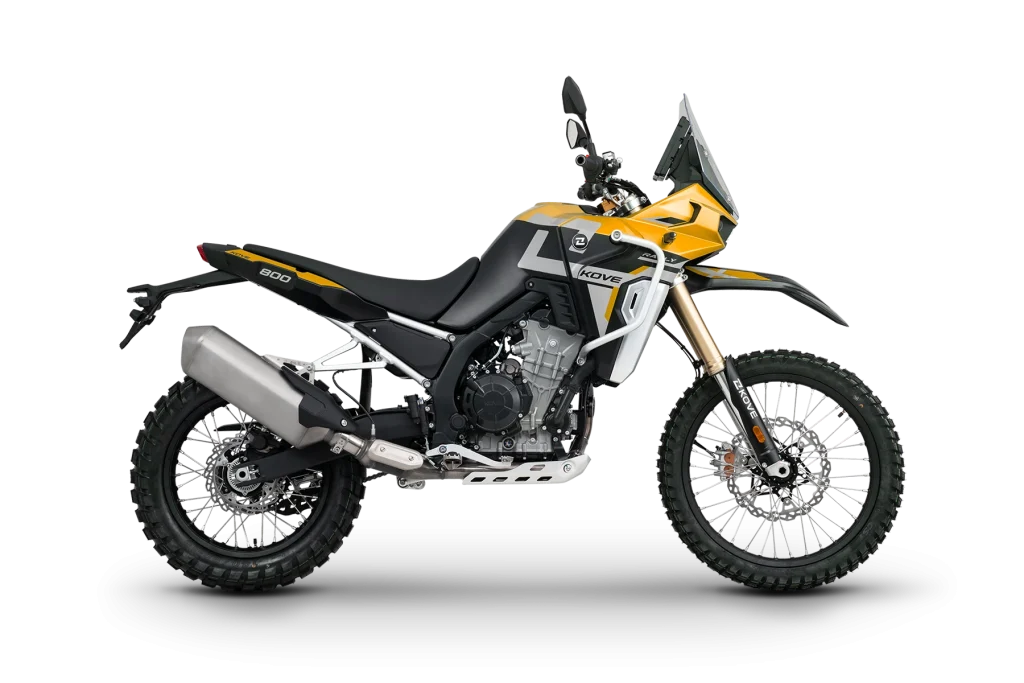
A bike’s physical package usually matters more than its image. Lighter machines are generally easier to recover after mistakes, easier to turn in technical sections, and less tiring when you have been standing for hours. Likewise, bigger tanks and sensible chassis dimensions can make a long-distance off-road navigation bike feel less demanding over a full route.
What to check first
- Curb weight: This affects recovery effort, low-speed control, and how tiring the bike feels in rough sections.
- Tank capacity: This shapes stage planning and how much flexibility you have between fuel stops.
- Seat height: This affects confidence at uneven stops and repeated remounts.
- Wheelbase and clearance: These influence straight-line stability and terrain tolerance.
- Suspension travel: This matters when pace rises and terrain becomes broken or whooped out.
KOVE numbers worth comparing
- KOVE 450 RALLY EX: 128 kg curb weight, 34 L tank, 960 mm seat height, 305 mm ground clearance, 1490 mm wheelbase.
- KOVE 450 RALLY RE: 155 kg curb weight, 32 L tank, 910/960 mm seat height, 255/295 mm ground clearance, 1475/1490 mm wheelbase.
- KOVE 800X RALLY: 176 kg curb weight, 20 L tank, 890 mm seat height, 293 mm ground clearance, 1540 mm wheelbase.
Why this matters
If you want a lightweight rally bike, the 450 RALLY EX stands out immediately on mass and fuel capacity. If you need a road-legal rally bike with serious range but a more flexible setup, the 450 RALLY RE looks like the more balanced choice. If you are choosing between rally feel and larger-displacement travel scope, the 800X RALLY brings the biggest engine while keeping proper 21-inch front and 18-inch rear wheel sizing.
Make sure you can stand and navigate for hours
Seated comfort matters, but it is not the first question on a long rally-style day. You will spend repeated stretches standing on the pegs, moving fore and aft, gripping the bike with your legs, and reading instruments while the terrain changes underneath you.
Step 3: Judge standing ergonomics, not just seated comfort
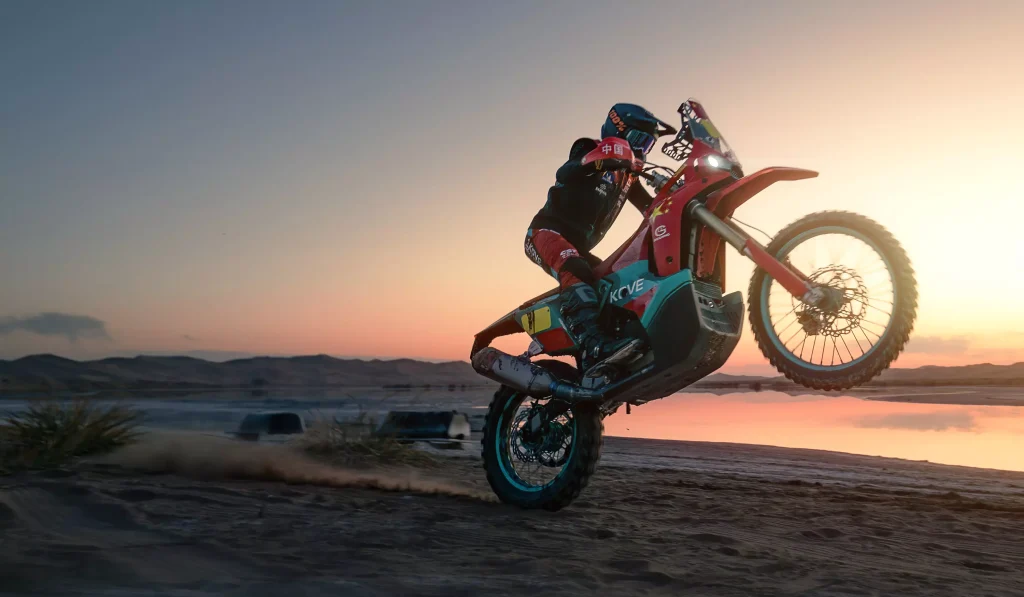
A rally bike for standing on the pegs should let you move naturally without loading your wrists or forcing you to brace against the bars. The best setup is not always the lowest seat or the tallest cockpit. Instead, it is the one that lets you stay neutral while standing and still manage slow, awkward stops when the surface turns uneven.
What to assess
- Stand on the pegs and check whether your elbows stay relaxed.
- Notice whether you can shift weight forward in turns and rearward in soft terrain.
- Check whether your knees grip the bike naturally.
- Confirm that you can still dab a foot confidently when tired.
- Look at instrument visibility while standing, not only while seated.
What to watch on KOVE models
The KOVE 450 RALLY RE and KOVE 800X RALLY both list TFT instrumentation, which supports a cleaner rider-information layout during longer navigation days. The KOVE 450 RALLY EX uses a tall 960 mm seat and long-travel chassis that better suits riders already comfortable with a committed off-road stance. By contrast, the lower 890 mm seat height of the KOVE 800X RALLY suggests a more accessible fit for riders who want rally-style capability on a bigger machine; that is an editorial inference drawn from the published specifications rather than a direct factory claim.
Common mistake
- Choosing the tallest bike because it looks more serious.
- Ignoring inseam confidence at the end of a six-hour day.
- Testing seated reach but not standing posture.
- Assuming more suspension travel automatically means better control for your skill level.
Look for gravel stability in the whole package
Fast open dirt rewards composure, not drama. A gravel-stable rally motorcycle depends on more than engine size, and many riders overvalue power while undervaluing the chassis details that actually settle the bike at speed.
Step 4: Balance engine character with chassis stability
You will get a clearer answer if you compare engine format, wheelbase, wheel sizes, suspension, and intended environment together. That is how to choose a rally bike that feels planted rather than simply quick in a straight line.
What to compare
- Single-cylinder versus twin-cylinder feel: Singles often keep weight down and feel more direct off road, while twins can feel smoother on longer mixed-distance routes.
- Wheelbase: Longer wheelbases can support better straight-line stability, though they may feel less eager in tighter turns.
- Wheel sizing: A 21-inch front and 18-inch rear remain the key off-road sizing for line choice and obstacle rollover.
- Suspension design and travel: These affect how the bike tracks over repeated impacts.
- Intended use: A purpose-built rally machine and a rally-influenced ADV bike may look similar but behave quite differently over a full day.
KOVE model framing
The KOVE 450 RALLY EX is best viewed as the focused option for extreme rally terrain and higher-speed desert-style riding. The KOVE 450 RALLY RE keeps rally architecture while adding road-legal flexibility, which matters if your routes include public-road connectors. The KOVE 800X RALLY pairs a 799 cc twin-cylinder engine with 176 kg curb weight, 270 mm front suspension travel, 240 mm rear travel, and a 1540 mm wheelbase, making it a sensible in-brand choice when you want rally character on a larger platform.
Quick troubleshooting if your shortlist still feels unclear
| Problem | Likely cause | Fix |
| Tiring after two hours standing | Cockpit fit mismatch | Recheck standing ergonomics |
| Too large in technical ground | Platform too heavy | Shift lighter and narrower |
| Fuel range feels marginal | Tank too small | Prioritise rally tank layout |
| Nervous on fast gravel | Chassis mismatch | Reassess wheelbase and suspension |
| Torn between rally and ADV | Use case too broad | Return to ride format |
Check ownership support before you commit
A bike can look right on paper and still become a difficult ownership choice if support is thin. For a rally motorcycle buying guide, this final step is less glamorous than suspension travel or tank size, yet it often decides whether the experience stays enjoyable after purchase.
Step 5: Confirm manuals, warranty, and service support

Before committing, verify that your chosen model has model-specific documentation, warranty coverage, and a realistic path to dealer or parts support. That does not tell you whether the bike is exciting; it tells you whether ownership will remain manageable once regular maintenance begins.
What to confirm
- The exact model appears in the official manuals section.
- Warranty documentation exists for the model family you want.
- There is a dealer pathway for sales, service, and parts.
- The published owner information matches your intended use and market.
KOVE ownership checks
KOVE’s service page provides manuals for 450 Rally, 450 Rally Ex, and 800X Rally, and it also lists a dedicated warranty policy reference for 450RALLY and 800X RALLY models. The same support area directs riders to authorised dealers for sales, service, and parts support. In addition, KOVE’s owner documentation warns that unauthorised modifications can affect safety, warranty cover, and legal road use, so it is worth reviewing the official paperwork before you choose a model for a mixed on-road and off-road role.
Practical buying scenarios
- If you need road legality for connecting sections, look first at the KOVE 450 RALLY RE.
- If you prioritise lower mass and maximum range for remote navigation-heavy terrain, the KOVE 450 RALLY EX makes the strongest case.
- If you are torn between a true rally setup and a larger adventure-rally format, the KOVE 800X RALLY is the natural cross-shop point inside the same brand line-up.
Choose the model that matches your route, movement, and support needs
The best rally bike for long days off road is not the most dramatic one on paper. It is the machine that matches your route format, your standing ergonomics, your fuel demands, and the level of stability you want when the pace rises on gravel. For some riders that will mean the road-legal flexibility of the KOVE 450 RALLY RE CN4/E5+. For others it will mean the lighter, more committed KOVE 450 RALLY EX, or the broader travel scope of the KOVE 800X RALLY CN4/E5+.
Which KOVE option fits best
- Choose KOVE 450 RALLY RE if you want a road-legal rally bike that still carries serious off-road intent.
- Choose KOVE 450 RALLY EX if you want the lightest and most rally-focused package for aggressive terrain.
- Choose KOVE 800X RALLY if you want a larger-capacity machine with rally ADV character and real off-road capability.