
Beyond Horsepower: How Top Sportbike Brands Approach Chassis Balance and Rider Feedback
SOURCE: KOVE
Walk into any motorcycle dealership or scroll through rider forums, and the conversation almost always starts with peak horsepower. It is easy to see why: big numbers look great on a spec sheet. Yet, anyone who has spent serious time carving through tight canyon roads or chasing lap times at a local track day knows a fundamental truth—raw engine output means very little if the frame cannot put that power to the pavement cleanly.
A lightweight sportbike with 70 hp and a communicative chassis will often leave a heavier, nervous 100 hp machine behind the moment the road starts twisting. When a bike tips into a corner at a 45° lean angle, your confidence comes from the frame, swingarm, and suspension telling you exactly what the tires are doing beneath you.
To understand what separates a merely fast motorcycle from a truly great handling one, we need to look past the engine block and examine how leading sportbike brands engineer balance, rigidity, and rider feedback.
What Actually Creates “Chassis Balance and Feedback”?
When riders talk about a bike feeling “planted,” “flickable,” or “numb,” they are describing the interplay of four core mechanical factors in motorcycle chassis design:
- Torsional vs. Lateral Rigidity: A common misconception is that a racing frame should be as stiff as possible. In reality, a frame needs high torsional rigidity (resistance to twisting under hard braking and acceleration) paired with carefully controlled lateral flex. At full lean, your front and rear sportbike suspension are angled away from vertical bumps. A frame with engineered lateral flex acts like a secondary spring, absorbing small mid-corner pavement ripples so the tires stay glued to the tarmac rather than chattering.
- Steering Geometry (Rake, Trail, and Wheelbase): Rake is the angle of the front forks relative to vertical, while trail is the distance between where the steering axis hits the ground and the center of the front tire’s contact patch. Steeper rake and shorter trail create quick, razor-sharp turn-in; more relaxed angles and a longer wheelbase prioritize high-speed straight-line stability.
- Mass Centralization and Unsprung Weight: Placing heavy components—like the engine, fuel tank, and exhaust—as close to the bike’s center of gravity as possible reduces rotational inertia, making side-to-side transitions feel effortless. Equally important is minimizing unsprung weight (wheels, brake rotors, and lower fork legs), which allows the suspension to react faster to road imperfections.
- Front-to-Rear Weight Distribution: A balanced static weight split—typically hovering right around 50:50 to 51:49—ensures that neither end of the motorcycle is overloaded. Under heavy braking, the rear tire maintains enough contact to prevent erratic hopping; under hard corner exits, the front tire retains enough downward load to keep steering crisp.
How Leading Sportbike Brands Approach Chassis Performance
Different manufacturers solve the handling puzzle in distinct ways, shaped by their racing heritage and target riding environments.
Yamaha: Precision Flex and the “Jin-Ki Kanno” Philosophy
Yamaha has long built its reputation around cornering precision rather than chasing the highest dyno numbers in a given class. Guided by its development philosophy of Jin-Ki Kanno—translating roughly to the exhilaration a rider feels when becoming one with the machine—Yamaha prioritizes front-end communication above all else.
The centerpiece of this approach on models like the YZF-R1 and YZF-R7 is the signature Deltabox aluminum twin-spar frame. Rather than using uniform wall thicknesses throughout the spars, Yamaha engineers vary the aluminum thickness across specific zones. This keeps the steering head and swingarm pivot rigid while allowing calculated lateral flex through the midsection. Combined with aggressive mass centralization, Yamaha sportbikes are widely praised by track riders for delivering transparent front-tire feedback right at the edge of grip.
Kawasaki: High-Speed Stability and Track-Bred Geometry
Where Yamaha emphasizes mid-corner delicacy, Kawasaki leans into high-speed composure and heavy-braking stability. Drawing directly from decades of World Superbike (WSBK) championship data, Kawasaki tunes its chassis geometry so the front end stays calm when scrubbing speed from triple-digit straights into tight hairpins.
Across its middleweight and lightweight lineups—including the Ninja ZX-4RR and Ninja 400/500—Kawasaki utilizes Finite Element Analysis (FEA) high-tensile steel trellis frames alongside aluminum twin-spar designs on its flagship superbikes. By using the engine itself as a stressed member of the frame, Kawasaki achieves high structural rigidity without unnecessary bulk. Paired with its Uni-Trak rear linkage ratios, a Kawasaki chassis is built to reward aggressive, late-braking riding styles with predictable straight-line tracking.
CFMOTO: Modern European-Style Balance and GP Aerodynamics
In recent years, CFMOTO has rapidly shifted the conversation around the modern chinese sport bike, focusing heavily on balanced street-to-track ergonomics and competitive component packaging. Influenced by European chassis tuning principles and active participation in the Moto3 and Moto2 Grand Prix paddocks, CFMOTO’s approach centers on approachable, confidence-inspiring neutrality.
On platforms like the 450SR (450SS in North America) and the three-cylinder 675SR-R, CFMOTO pairs a lightweight chromoly steel trellis frame with an aluminum subframe and a near-50:50 weight distribution. By integrating adjustable KYB suspension components, steering dampers, and wind-tunnel-tested aerodynamic winglets that stabilize the front end at speed, CFMOTO builds chassis platforms that feel forgiving on rough public roads while remaining composed during spirited weekend canyon runs.
Where KOVE Fits In: Engineering Lightweight Agility from the Track Up
While every top manufacturer balances rigidity, geometry, and suspension, physics dictates one undeniable rule: cutting weight improves every single aspect of chassis performance simultaneously. A lighter motorcycle requires less braking force to slow down, puts less thermal stress on tires, and allows the suspension to track bumps with minimal inertia.
That weight-obsessed mindset is the foundation of every KOVE sportbike. Rather than building a heavy street bike and adding power to compensate, KOVE starts with strict weight targets and track-derived geometry from the drawing board up.
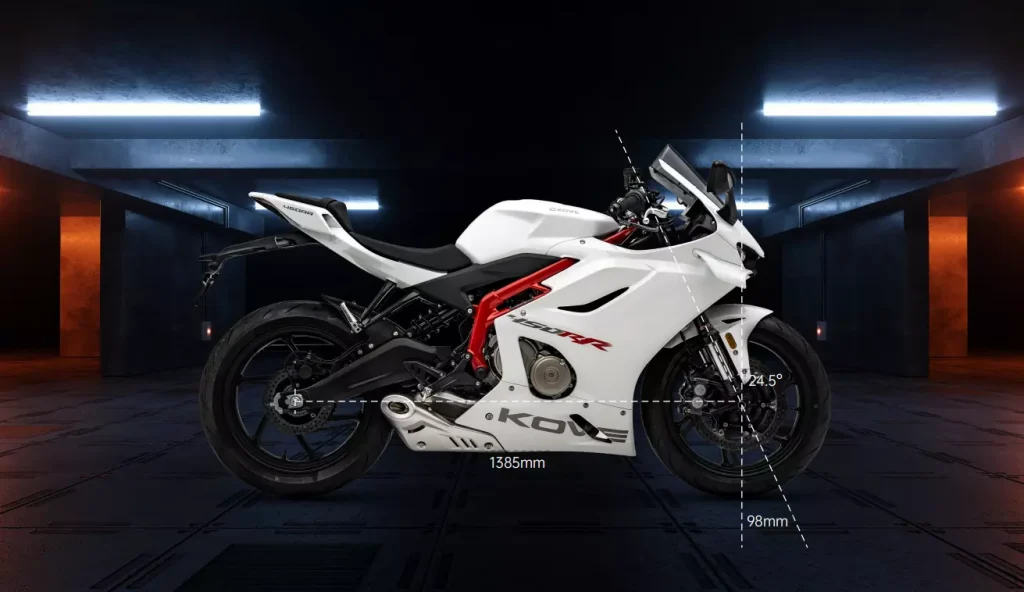
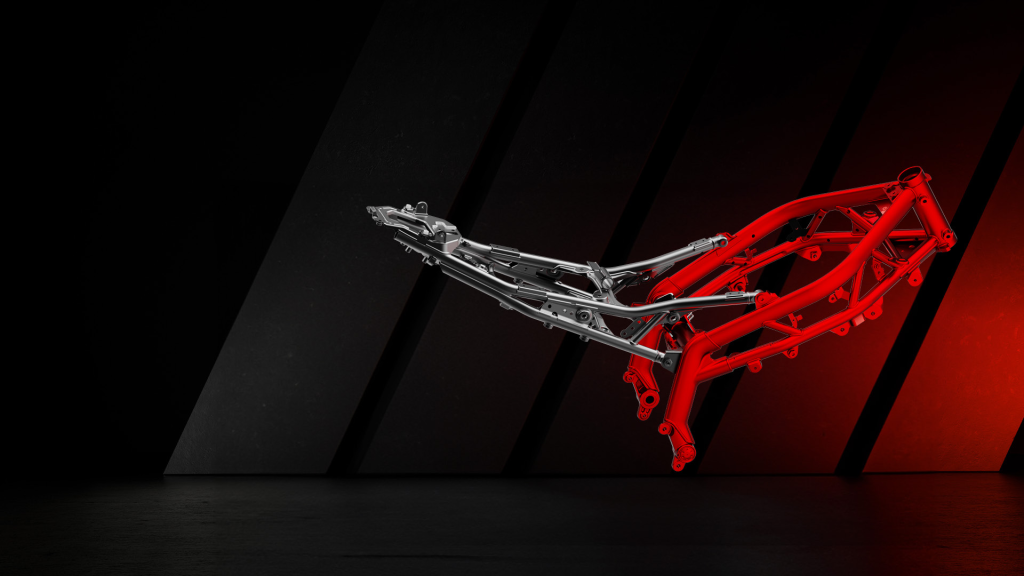
- The 450RR Benchmark: As an inline 4 cylinder motorcycle, the flagship KOVE 450RR achieves a remarkable 165 kg (364 lbs) wet weight—significantly lighter than traditional four-cylinder machines in the 400cc–500cc segment. To hit that figure without sacrificing high-rpm stability, KOVE pairs an HC700 high-strength steel trellis main frame with an aluminum twin-spar gull-arm swingarm. Combined with a 51:49 front-to-rear weight distribution, a compact 1,385 mm wheelbase, a standard steering damper, and a fully adjustable 41 mm KYB inverted fork, the 450RR delivers instant directional changes and unfiltered road feel.
- Scalable Race Geometry Across Displacements: That same chassis DNA carries straight down through KOVE’s lightweight lineup. The KOVE 350RR and KOVE 250RR bring ultra-low curb weights, sharp steering geometry, and rigid trellis architectures to riders honing their cornering craft, proving that approachable displacement classes deserve authentic track-ready feedback rather than watered-down commuter frames.
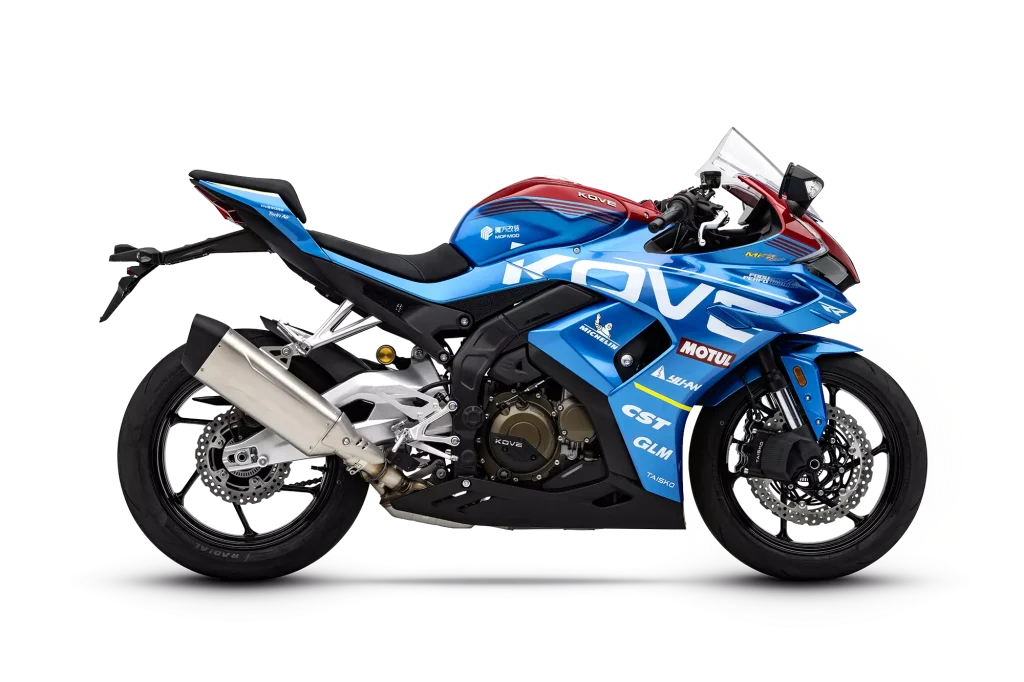
KOVE’s development in the sportbike segment continues with the newly unveiled 650RR, which brings the brand into a higher-displacement inline-four category.
The 650RR features a newly developed 645cc liquid-cooled inline four-cylinder engine producing 80 kW at 13,000 rpm and 60 N·m at 11,000 rpm.
Its chassis uses a high-strength twin-spar frame, an aluminium subframe, and an aluminium swingarm. The motorcycle also incorporates adjustable suspension and an advanced electronic package that includes a six-axis IMU, cornering ABS, traction control, and a bi-directional quickshifter.
These features show KOVE’s intention to combine stronger engine performance with modern chassis engineering and electronic rider support.
The 650RR is scheduled for its first deliveries in the third quarter of 2027. Its introduction represents another step in KOVE’s expansion into the middleweight sportbike segment.
How to Evaluate Chassis Feel on Your Next Test Ride?
Next time you throw a leg over a sportbike, ignore the brochure for ten minutes and pay attention to how the chassis communicates through your hands, hips, and feet during three specific maneuvers:
- Trail-Braking Into a Corner: As you ease off the front brake while leaning in, notice whether the bike wants to stand up and run wide or naturally drops toward the apex. A well-balanced chassis transitions smoothly without fighting your handlebar inputs.
- Mid-Corner Surface Imperfections: Hit a small seam or ripple while leaned over. A well-tuned frame and suspension combo will absorb the bump and hold its line; an overly rigid or poorly damped setup will skip outward and unsettle your confidence.
- Quick Left-Right Transitions (Chicanes): Flip the bike from one side to the other at moderate speed. Look for low rotational inertia—the motorcycle should respond immediately to counter-steering without feeling top-heavy or sluggish at the rear.
Ready to Feel What True Lightweight Balance Does on the Road?
Spec sheets only tell half the story—real rider confidence happens when mass, geometry, and suspension work in complete harmony. If you want to see how a 165 kg four-cylinder machine changes the way you attack corners, explore the full engineering specs of the KOVE 450RR, compare the nimble KOVE 350RR and KOVE 250RR, or locate an authorized dealer near you to experience KOVE’s track-bred chassis firsthand.