
Does a Lightweight ADV Motorcycle Really Perform Better Off-Road?
SOURCE: KOVE
If you’ve spent any time on adventure riding forums, or you’ve watched trail review videos, you’ve basically seen weight come up a lot in the discourse. “Too heavy for serious off-road.” “You want something lighter.” But how much does bike weight really matter out there, and does lighter always mean better?
In this article, we look at how the weight and weight distribution of an ADV bike influence real-world off-road riding, why a lighter bike can make a difference, and when that difference really matters.

What Difference Does Motorcycle Weight Make Off-Road?
Weight makes itself known in ways you don’t always anticipate until you’re actually riding off pavement. It’s not just about the number on the label.
A lighter bike is typically simpler to balance at low speed, and quicker to fix when things start feeling a bit wobbly. But whether you’re working your way through a challenging, rocky section or negotiating a tiny path, you’re not necessarily fighting the bike’s heft just to stay on course.
In tight, broken terrain, changing direction and staying in control also takes noticeably less effort. The bike responds to your inputs more readily, which makes a real difference when the trail keeps throwing obstacles at you.
On technical terrain, tip-overs are inevitable. A lighter adventure bike makes picking it back up easier after an accidental fall—particularly when fatigued, riding alone, or the terrain doesn’t align to your favor. On long days on tough trails, physical disparity becomes apparent more quickly than most riders expect.
That said, weight advantages don’t show up equally across every situation. On open fire roads or at highway speeds, a heavier bike can actually feel more settled and predictable.
| Riding Situation | Lightweight ADV | Heavier ADV |
| Low-speed control | Easier | More demanding |
| Tight trails | Easier to maneuver | Needs more rider input |
| Mud and sand recovery | Usually easier | More physically demanding |
| Picking up the bike | Easier | Harder |
| High-speed stability | Depends on design | May feel more planted |
Bike Weight Isn’t the Whole Story
Many riders fall into the trap of comparing two bikes on curb weight alone and assume the lighter figure automatically wins off-road. In practice it is rarely so simple.
Two ADV bikes with the same curb weight can feel very different off-road because that weight may be distributed differently across the motorcycle.
- Center of gravity: When riding at moderate speeds over uneven ground, having a motorcycle with a low and properly placed center of gravity can make the bike easier to manage and balance.
- Steering response: Bikes with high or forward weight bias tend to feel heavy and cumbersome when correcting, even if their overall numbers look reasonable.
- Fuel, luggage, and gear: Fuel, luggage and gear are another important factor. When packing for a multi-day trip, the balance point changes significantly. What seems manageable on a bare bike can be very different on a fully loaded bike.
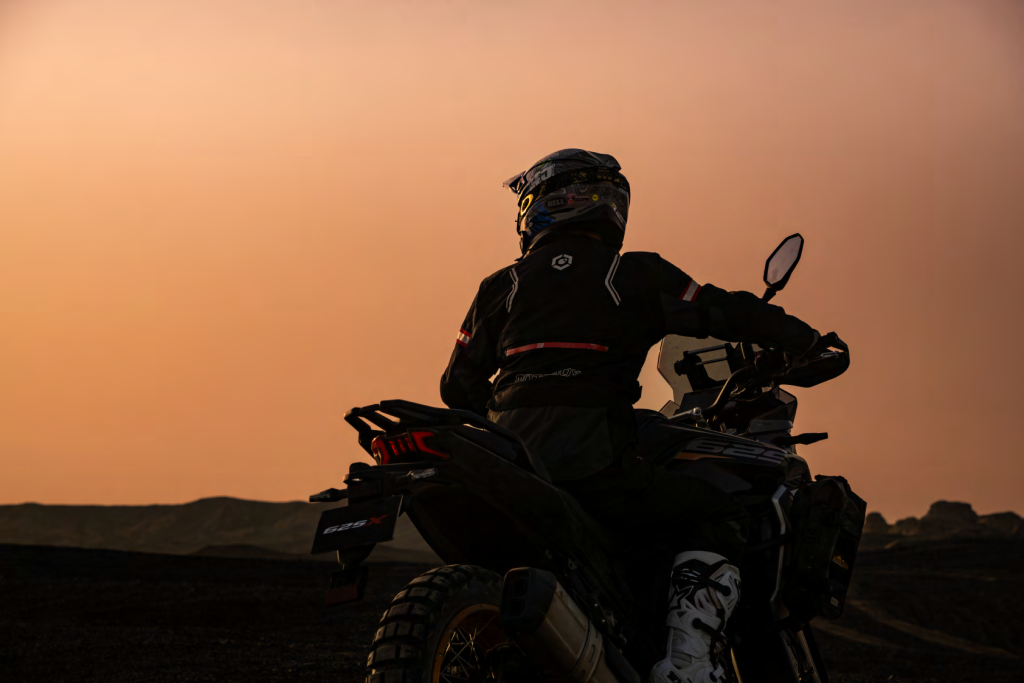
Additionally, off road motorcycle performance depends on more than just weight. A few other specs that make a genuine difference:
- Ground clearance: The distance between the lowest part of the motorcycle and the ground, which affects how easily it can clear rocks, ruts and other obstacles.
- Suspension travel: More travel absorbs bigger hits while keeping wheels planted over uneven terrain.
- Wheel and tire setup: Off-road-oriented tires make a much bigger difference to traction on sand, mud and gravel than wheel type alone. Spoke wheels are also commonly used on off-road-oriented ADV bikes because they can be more suitable for absorbing repeated impacts and rough terrain.
- Seat height: Impacts on your confidence in placing a foot down at low speeds, while stopped on a hill, or when the ground drops away unexpectedly.
When Does a Lighter ADV Help Most?
There are riding scenarios when a lightweight ADV motorcycle gives you a real, noticeable advantage over a heavy machine.
1. Technical trails
A lightweight bike is best suited to technical trails like tight woodland tracks, rocky sections, and routes with numerous direction changes. A lighter bike generally requires less physical effort to change direction and correct your line, which becomes especially noticeable on tight technical trails. Here is where one truly experiences the difference between lightweight adventure bikes and their heavier counterparts.
2. Sand and mud
Getting trapped on soft terrain is a physical drain. If, after a tip-over or a spin-out, you can wrestle the bike back into a rideable posture without totally emptying your tank, that means a lot. Lighter bikes tend to get away from these situations with less effort and less physical strain.
3. Steep climbs and descents
Lighter bikes tend to be easier to handle on steep ascents and descents; however, engine performance, braking control and tire selection remain key elements. Thus power and tire grip play an integral role here. A heavier bike can still perform well if it has adequate power, traction and braking control.
4. Mixed road riding
Chasing the lowest possible weight is not the correct priority for most of your riding on asphalt with the rare mud stretch. If you are touring, not trail riding, then stability at speed, rider comfort, fuel range and load carrying capacity are all worthy of serious consideration.

Is a Lighter ADV Always Better?
No. If you really want a bike for technical off-road use, then a lighter bike will generally give you great advantages in terms of control, recuperation and reducing rider fatigue. A little more weight can often help whether you’re riding on roads, touring long distances or carrying a full load of kit. The heavier bike is more predictable at speed and less likely to be jostled on bad pavement.
It’s not about the numbers that appear good on paper, it’s about where and how you actually ride.
Final Thoughts
Weight absolutely deserves space in your checklist when you’re picking an adventure motorcycle. But it’s only one part of a bigger picture. The top lightweight adventure motorcycles earn the name because weight is handled with intention across the whole machine: the frame geometry makes sense, the suspension is tuned properly, and the entire setup matches the kind of trips you’re actually going to do, not just the spec sheet.
At KOVE, the ADV lineup is built around that kind of balance. From technical off-roading adventures on the 525X to longer mixed terrain adventures with 625X models—each is designed for real world performance. Explore the KOVE ADV range and see which one fits your riding.